
1The Challenge
What was the challenge?
Savista came with a theme rather than a wish-list, and the theme did the work: Back to Basics. The two behaviours it needed to land were specific and operational — being first-time right, and being proactive rather than reactive.
Those are hard things to teach in a room. Everyone agrees with them in principle. Nobody disputes that accuracy on the first attempt beats rework, or that anticipating a problem beats scrambling when it arrives. The difficulty is that agreement changes nothing; people only revise how they work when they've felt the cost of not doing it. A conventional session on quality and planning would have produced nodding and no change.
There were practical constraints too. The programme ran twice, in two cities a week apart, with different groups of 80–90 and 70–80 — so the experience had to be consistent enough that both cohorts came away with the same message. And these were returning participants, who needed something they hadn't done before.
2Our Solution
What solution did we design?
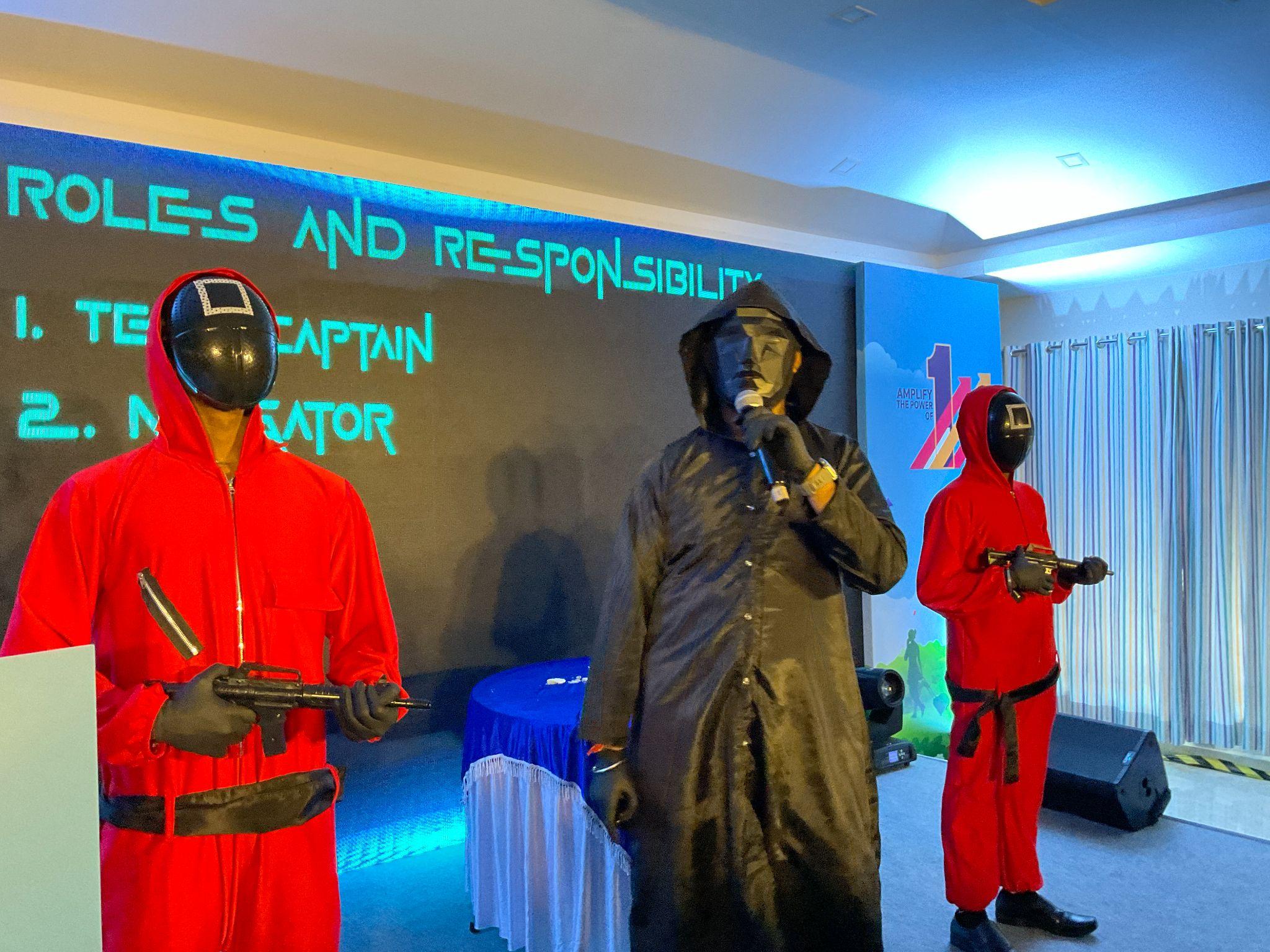
Squid Games was selected because its mechanics enforce the theme rather than describe it.
Each challenge demands accuracy on the very first attempt. One mistake costs the team time — or elimination. That single design feature transforms the abstract idea of "first-time right" into something with immediate, visible consequences: teams that skim the instructions and rush in lose, while teams that read carefully, plan smartly, and execute with precision advance. The lesson isn't delivered in the debrief; it's delivered in the round.
The second behaviour comes from the format's twists. Rounds shift and conditions change, so teams that simply react to what's in front of them fall behind, while those that anticipate what's coming, hold quick strategy discussions, and align early gain a real edge. Anticipation and preparedness directly determine survival — which is as close to a literal demonstration of "proactive, not reactive" as an activity can get.
That's the fit: Squid Games rewards teams who think ahead and execute right the first time, which is precisely what Back to Basics asks of Savista's people. The high-energy, competitive format also gave a returning audience something fresh, while carrying a genuinely serious point underneath the fun.
3How We Did It
How was the programme delivered?
The programme ran twice — Chennai on 9th January at MGM Beach Resorts, Noida on 16th January at the Radisson Blu MBD — with a consistent format across both so each cohort had the same experience and the same takeaways.
Participants competed in teams of roughly eight groups per session, moving through the sequence of challenges with elimination pressure running throughout. Two facilitators ran each session, working alongside the event partner on setup, and observed how teams behaved under the format's demands: who read the brief properly before starting, who paused to plan when a twist landed, and who reacted rather than anticipated.
The debrief drew directly on those observations and stayed anchored to Savista's theme. Rather than discussing quality and planning in the abstract, facilitators pointed at what had just happened in the room — the round lost to a misread instruction, the team that gained ground by aligning early — and connected it to Back to Basics: getting things right from the start, and staying ahead of the work rather than chasing it.
4Key Outcomes
What were the results?
Squid Games gave Savista's teams across both cities a felt, unarguable experience of the Back to Basics theme. Being first-time right stopped being a principle people agree with and became a round they either won or lost; being proactive rather than reactive became the difference between anticipating a twist and being caught by it.
Delivered consistently across Chennai and Noida to roughly 160 people, the programme gave two cohorts a shared reference point — and a theme they had lived rather than been told.