
1The Challenge
What was the challenge?
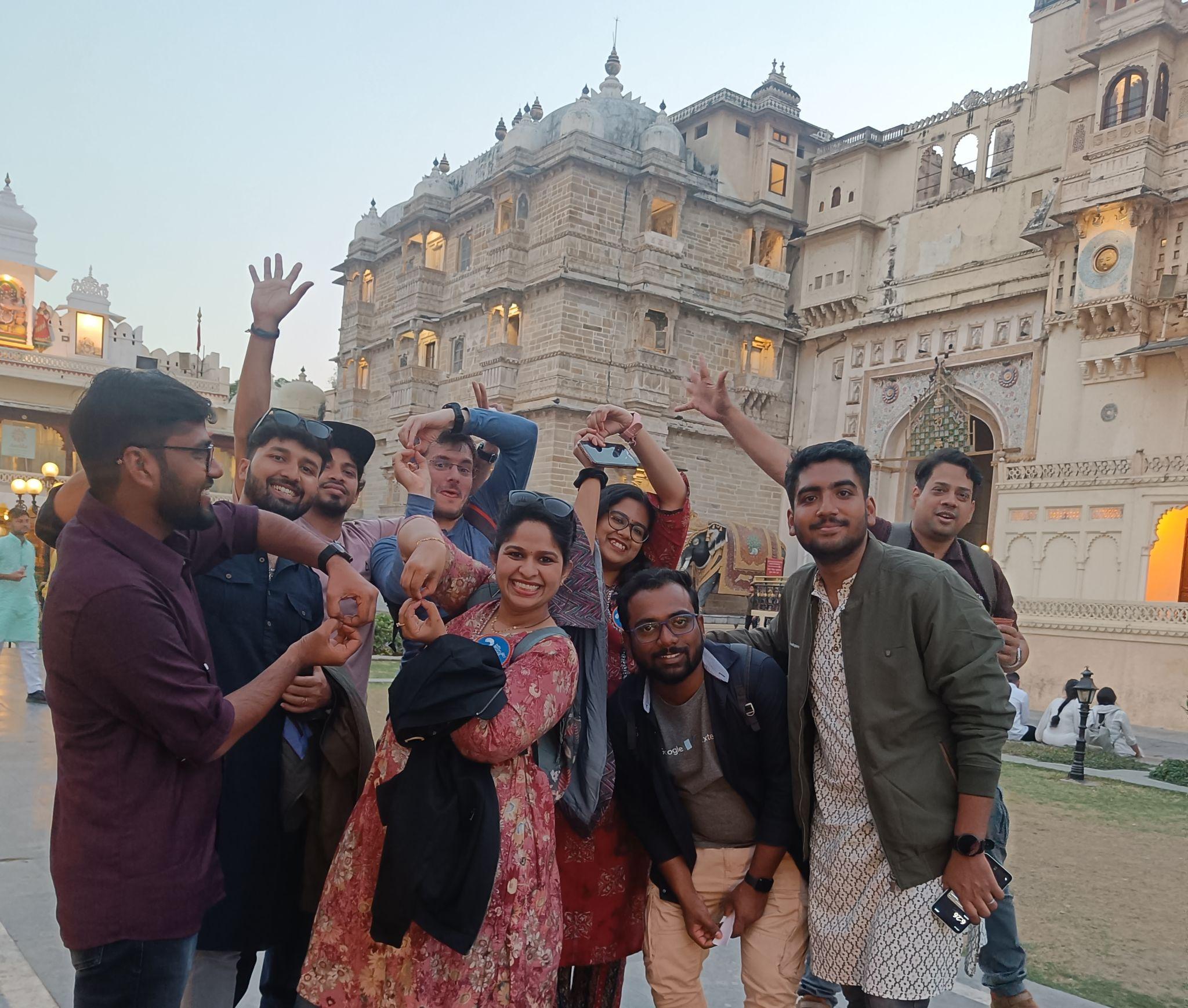
Google brought 200 people to Udaipur and wanted the team-building segment to do something more interesting than fill a slot in the agenda. The setting was extraordinary — the City Palace, the lake, the old city — and the brief was to actually use it rather than treat it as backdrop.
The constraints were real, though. The race ran in a live public space, not a hired venue: a perimeter of roughly one to one and a half kilometres around the City Palace, shared with the public, with challenge stations subject to availability, permissions, and physical space. Some stations could realistically handle only ten to fifteen people at a time. Threading 20 teams through that without queues, congestion, or dead time is a genuine operational problem.
The window was tight too — the race itself ran 4:30 to 6:00 pm, following a guided City Palace visit and preceding a cultural dinner. And this was Google: the client wanted the game questions genuinely difficult and puzzly, with the briefing deck and the platform content both verified by their team for quality, grammar, and sentence construction before going live. A generic treasure hunt would not have passed.
2Our Solution
What solution did we design?
The Rajasthan City Race was designed as a route through the culture of the place rather than a scavenger hunt that happened to be in Rajasthan. Teams moved between challenge stations around the City Palace, mixing digital puzzle challenges with hands-on local experiences delivered by the artisans and performers who actually practise them:
A Rajasthani puppetry workshop, where teams built a pair of puppets — and the puppeteer himself decided whether the construction was good enough to pass. A folk dance-off, learning a traditional sequence and performing it publicly while balancing matkas on their heads. A Rajput archery contest. A spot-the-difference challenge between two intricate miniature paintings, judged by the artist. Matki Phod, building a human pyramid to break a clay pot in the traditional ritual. A folk music jam, where teams had to learn a tune from a musician well enough that he'd hand over the next clue. Finding the man with the longest moustache for a selfie. Making their own jalebi. And a COMMUNITY letter challenge tying the route together.
The design decision that makes this work is the gatekeeping: at several stations, the local artist or performer holds the pass/fail. Teams can't bluff their way past a puppeteer or a musician — they have to actually learn something. That turns a race into genuine cultural participation, and it's what separates this from a themed hunt with props.
On the digital side, the puzzle content was built to Google's specification — difficult, properly puzzly, and put through client verification for quality and construction before the race went live.
3How We Did It
How was the programme delivered?
The day ran to a carefully sequenced flow. A briefing session at 12:30 pm set up the race before participants broke for lunch. At 3:30 the teams gathered, and from 4:00 to 4:30 a guide took them through the City Palace itself — context and atmosphere before the competition began. The Rajasthan City Race then ran from 4:30 to 6:00 pm around the palace precinct, with the group heading to Shikharbadi afterwards for a cultural dinner, where the top three teams were announced at 7:30 and hampers presented.
Operationally, the race was built around its constraints rather than against them. Between six and nine local experiences were staged depending on availability and permissions, with substitutions planned in advance so the route stayed intact if a station became unavailable. Teams were routed to avoid stations designed for ten to fifteen people receiving all 20 teams at once. A facilitation team of at least three coordinated the race across a live public perimeter, working alongside the event partner on start and end points, and with client-provided wi-fi supporting the digital platform throughout.
The result was 200 people moving through a public heritage precinct in a way that felt like discovery rather than logistics.
4Key Outcomes
What were the results?
The Rajasthan City Race gave Google's 200-strong group an evening of genuine cultural participation rather than a themed activity — learning a folk tune from the musician who plays it, building puppets a puppeteer would accept, breaking a matki the traditional way, all against the backdrop of Udaipur's City Palace.
Coordinating 20 teams through a live public heritage precinct, within a 90-minute window and around real-world availability constraints, the race delivered scale and authenticity together — and closed a day in Udaipur with a shared experience the group had genuinely earned.