
1The Challenge
What was the challenge?
Okta runs a monthly engagement session for its global team, and the brief was refreshingly direct: make it fun. No transformation agenda, no learning objectives — just an hour that people across time zones would be glad they joined.
Simple briefs are rarely easy. A virtual session with 50 people has to earn attention it can't assume, with no room for a slow start before the room drifts back to their inboxes. And the audience was spread across geographies, which cuts both ways: it's what makes the session valuable, and it's what makes a shared experience hard to manufacture over video.
There was also a technical constraint that mattered more than most. Okta is a security company with its own firewall, and a previous programme run by a different vendor had faltered when the game link simply didn't work. Whatever ran had to work first time — no whitelisting requests, no IT ticket, no twenty minutes of the hour lost to troubleshooting.
2Our Solution
What solution did we design?
The Go Global Treasure Hunt was chosen because its central conceit matches the audience exactly. Teams race through a series of destination-based challenges spanning the world, unlocking clues and solving puzzles as they travel from country to country — a format that turns the group's own international spread into the theme rather than an obstacle.
For a distributed team, that's the difference between a video call and an event. Colleagues in different countries find themselves solving problems about places some of them actually live, and the geographic diversity that usually makes virtual sessions feel fragmented becomes the source of the fun. The hunt splits 50 people into small teams where nobody can quietly disappear, moves fast enough to hold attention across a full hour, and produces a live competitive arc with a clear finish — the shape that makes a remote session feel like something happened.
Technically, it ran on infrastructure already verified against Okta's environment. The game links had been tested in advance and confirmed to work with no whitelisting required, so the session could start on time and stay there.
The Go Global Treasure Hunt formed part of a three-programme package Okta booked for its monthly engagement series.
3How We Did It
How was the programme delivered?
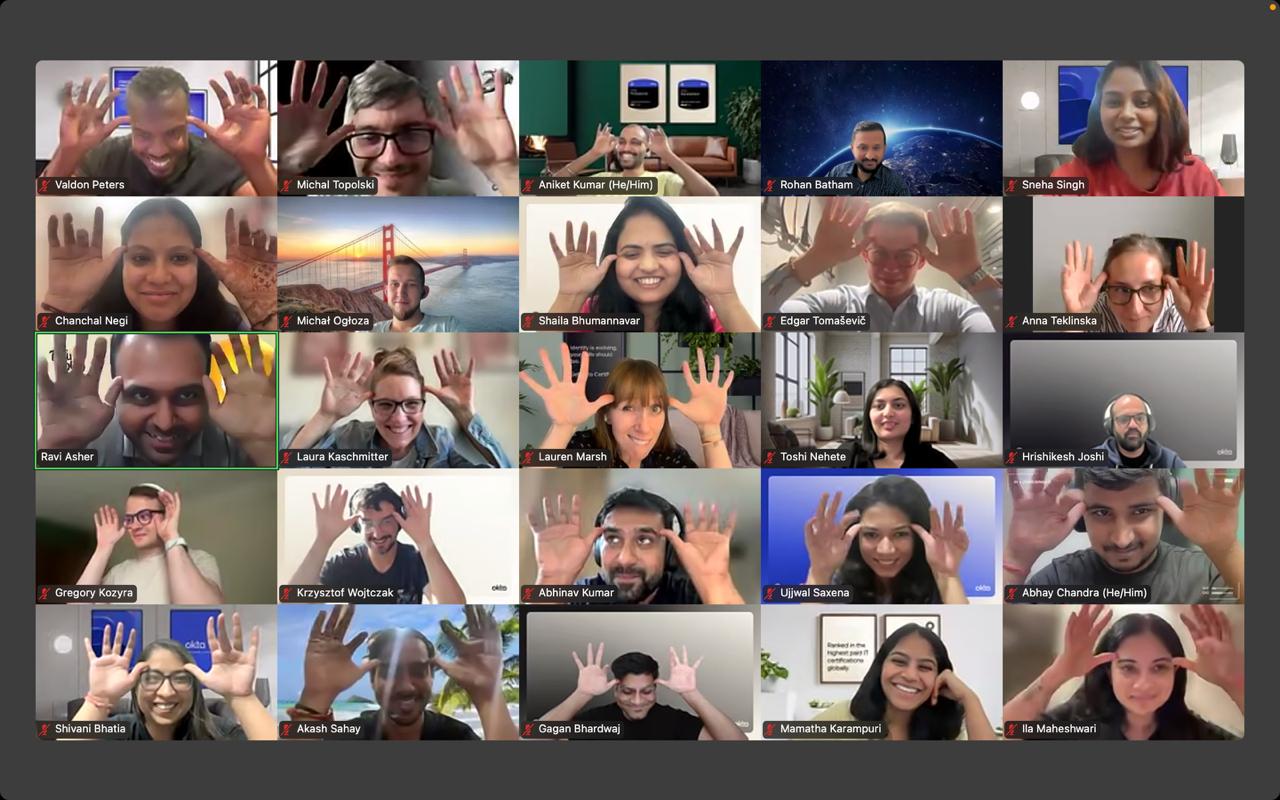
The 50 participants joined over Zoom and were divided into mixed teams, deliberately cutting across function and geography so people worked with colleagues they don't encounter day to day. Teams were briefed and moved straight into the hunt, with a hard one-hour clock running.
A team of three to four facilitators ran the session, moving between breakout rooms to keep energy high, unstick teams, and hold the pace. That ratio matters at this scale: with 50 people across breakouts, a single facilitator inevitably leaves groups waiting — and in a one-hour session, waiting is what kills it.
Teams worked through the destination challenges in sequence, returning to the main room for the finish and the results.
4Key Outcomes
What were the results?
The Go Global Treasure Hunt gave Okta's international team an hour that used their global spread as the point rather than working around it — 50 people in different countries racing through the same set of destinations together.
Just as importantly, the hour was an hour: nothing broke, nothing needed a whitelisting exception, and no time was lost to a link that wouldn't open — a meaningful contrast to their previous experience, and a non-trivial win inside a security company's environment.