
1The Challenge
What was the challenge?
This was the second year WTW had run a programme with us, and the same cohort — around 30 returning participants plus 10 new additions — was reconvening after a full year. The previous session, "Everyday Leadership," had planted ideas the group had been applying across the year, and WTW wanted this year to feel like a genuine sequel: opening by revisiting how people had put those earlier learnings into practice, then building forward from there.
The content brief was demanding and specific. The emphasis was on forward-thinking, planning, and execution as they apply to daily deliverables — goal setting, breaking goals into actionable steps, estimating time and resources, anticipating roadblocks, tracking progress against milestones, and making accountability and ownership the standout takeaways. Harder still, the room held two distinct audiences with different needs: people managers, who needed to focus on allocating team members to the right roles and delegating; and individual contributors, who needed to prioritise their own work by impact and use their time well. The workshop had to serve both without shortchanging either.
2Our Solution
What solution did we design?
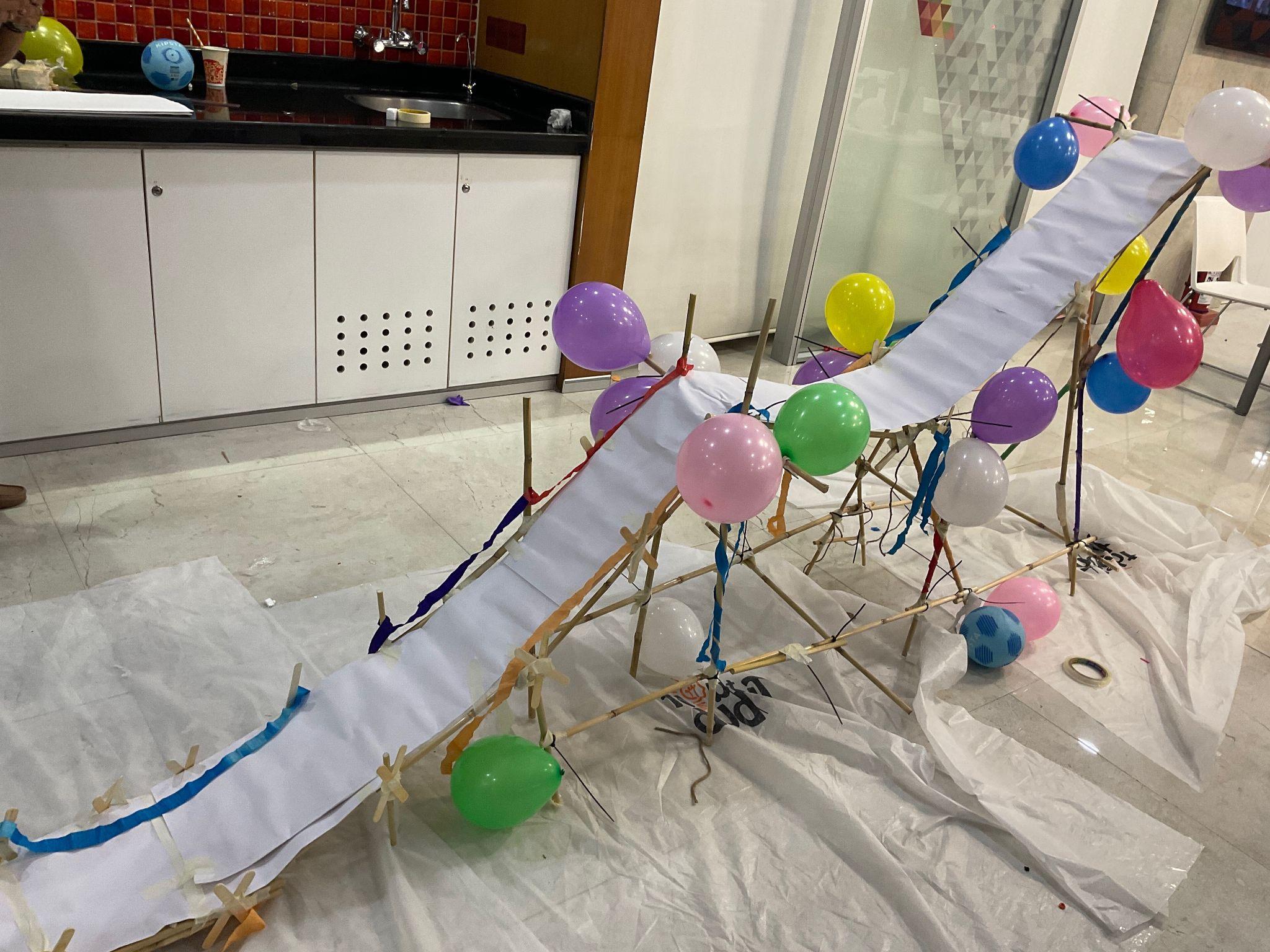
The Columbus Challenge was chosen because it compresses the entire planning-to-execution cycle into a single, vivid experience. Framed as an expedition into the unknown, teams must set a goal, plan a route, allocate limited time and resources, anticipate what could go wrong, and then execute against their plan while the conditions test it. It surfaces, in real time, exactly the capabilities WTW named: goal setting, breaking objectives into steps, resource estimation, roadblock anticipation, and — crucially — the gap that opens up between a plan on paper and its execution under pressure.
It also naturally holds both audiences at once. Within each team, the planning-and-allocation dimension gives people managers a live rehearsal of delegation and putting the right person on the right task, while the prioritisation-and-time dimension gives individual contributors a direct experience of sequencing work by impact. Everyone is doing the same challenge, but each role finds its own lesson in it — which is precisely what the brief required. And because execution is where the challenge bites, ownership and accountability emerge as the strong, unmistakable takeaways WTW wanted.
The Columbus Challenge sat within a full-day flow alongside a themed Movie Making Challenge and the Radio Relay Challenge — the latter reinforcing the communication and clarity that planning and execution depend on. Interactive case studies were woven in to connect the experiential lessons to participants' real day-to-day scenarios, giving the takeaways practical grip.
3How We Did It
How was the programme delivered?
The day opened with context-setting deliberately framed as a continuation of the previous year — inviting participants to reflect on how they'd applied the "Everyday Leadership" learnings over the intervening months so the new group of returners felt a genuine throughline rather than a fresh start, while the 10 new joiners were brought into the shared narrative.
For the Columbus Challenge, the 40 participants worked in teams through the plan-and-execute cycle, with facilitators observing how each team set goals, allocated its people and resources, and adapted when execution met friction. Two facilitators ran the day, drawing out role-specific lessons for managers and ICs as they went, and using milestone checkpoints within the activity to make the "are we actually implementing the plan?" question concrete. The debrief connected the experience to practical planning and execution frameworks and to the interactive case studies, ensuring participants left with tools they could apply to real deliverables — and with execution and ownership as the clearest takeaways of the day.
4Key Outcomes
What were the results?
The Columbus Challenge gave WTW's team a compressed, hands-on run through the full arc from planning to execution — and let both managers and individual contributors find their own lesson inside the same experience. Ownership and accountability emerged as the day's strongest takeaways, exactly as the brief intended.
As a sequel to the previous year's "Everyday Leadership" session, the workshop extended a multi-year development relationship – connecting last year's learnings to this year's focus on planning and execution and giving a returning cohort a clear sense of progression.